Michael Corleone's purge
The GodfatherMichael Corleone's purge is the decisive counteroffensive that transforms a weakened Corleone Family into the dominant power among the New York Families. Conducted under the cover of a secret meeting and a carefully staged dispersal of relatives, it combines targeted assassinations, the exposure and execution of Carlo Rizzi, and a rapid seizure of hostile territories. Its significance lies not only in the bodies left behind but in the transfer of power from the old Don's personal authority to Michael's colder, more systematic command.
Causes and Strategic Background
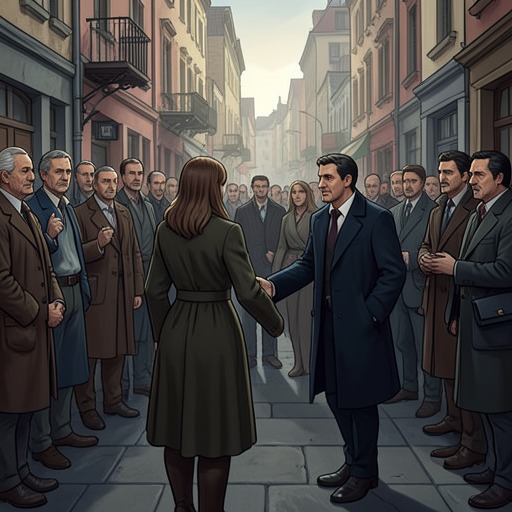
The purge follows a period in which the Corleone Family's position had visibly deteriorated. After Don Vito Corleone's peace with the Five Families, the Barzini Family had become the strongest organization in the New York area. Allied with the Tattaglia Family, it had begun entering Corleone gambling territories, installing its own bookmakers, and testing the family's willingness to resist. The meeting at the Long Beach mall therefore occurs against a background of encroachment, declining influence, and uncertainty over whether Michael can inherit authority that had never automatically passed by blood.
Michael's method is inseparable from the organizational structure created by Don Vito Corleone. The old Don had divided operations among caporegimes, inserted layers of insulation between himself and violent acts, and restricted contact between Peter Clemenza and Salvatore Tessio as a security measure. The same logic of buffers, compartmentalization, and deniable orders now serves Michael. The purge is not a spontaneous outburst of revenge. It is an administrative operation whose participants often know only their immediate assignment, while Michael remains concealed behind intermediaries, movements, and false appearances.
The operation also answers the older code of obligation that governs the Family. Don Vito Corleone's power had been built through favors: people came to him for jobs, legal assistance, money, protection, and intervention, then acknowledged a debt that could later be redeemed. That system presented itself as friendship while creating a durable structure of dependence. Michael inherits this system but strips away much of its paternal warmth. His purge shows the same alternative-government logic in its coercive form: protection is inseparable from surveillance, loyalty from obedience, and peace from the credible threat of elimination.
The Secret Preparation
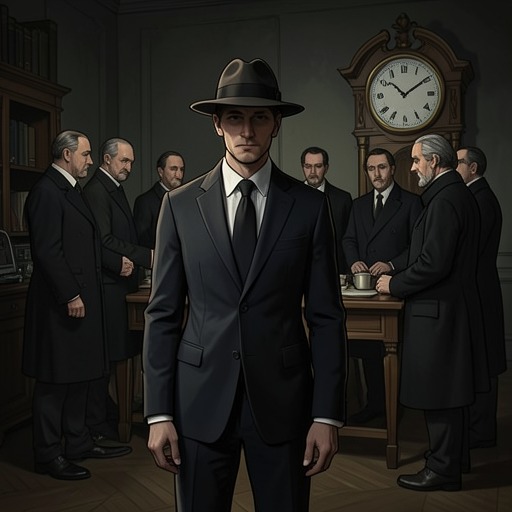
On the day of the purge, Michael arranges for Constanzia Corleone, her mother, Carlo Rizzi, and their children to leave for Las Vegas, while Kay Adams and the children are sent toward New Hampshire. The departures appear to be ordinary family travel, but Michael has ordered the movement of the household so that almost everyone will be away before the secret meeting between the Corleone and Barzini Families. Only the Family's capos know what is being prepared. Carlo is told to remain behind temporarily, a delay that isolates him from his wife and places him within Michael's reach.
At the same time, Michael positions his men across separate routes and identities. Rocco Lampone supervises the gate and receives an opaque telephone message telling him that his package is ready. A gunman travels to a bakery to find Fabrizzio, the man associated with Michael's exile and the killing of Apollonia Vitelli. Albert Neri prepares a police uniform, a holster, a cap, and a police shield that remained in his possession after his suspension. Clemenza waits for instructions. These details give the purge the texture of a coordinated network rather than a single attack: vehicles, phones, uniforms, aliases, and controlled access all make violence appear to be part of an impersonal mechanism.
The plan's secrecy is reinforced by Michael's physical absence from the family scene. He remains closeted with Tom Hagen while relatives search for him, and Hagen tells him that it is time to begin moving. Michael wishes that Don Vito Corleone had lived longer, an acknowledgment that the succession has arrived before he feels ready for it. Yet the regret does not halt the operation. The old Don's authority is passing into a new form, and Michael's first fully visible act as chief must be an act of concealment and destruction.
Targeted Assassinations
The first visible strike occurs in a bakery. The gunman asks the counterman about a tattoo, then shoots him repeatedly when the man cannot provide the answer. He tears open the victim's shirt and discovers the tattoo of intertwined lovers pierced by a knife. The identification confirms that the victim is Fabrizzio. The gunman then states that Michael Corleone sends his regards and fires at close range before escaping in a waiting car. The killing closes a long account connected to Apollonia Vitelli's death, but its presentation is deliberately procedural: recognition, confirmation, execution, extraction.
Rocco Lampone carries out the attack on Philip Tattaglia. After leaving the mall by way of the Jones Beach Causeway, the same route on which Santino Corleone was killed, he changes vehicles and reaches a motel. There he finds the seventy-year-old Philip Tattaglia with a young girl. Lampone fires four bullets into Tattaglia's abdomen, returns to the waiting car, and soon comes back to the mall to report to Michael before resuming his position at the gate. The route links the new violence to the earlier assassination of Santino Corleone, turning geography into a record of unfinished retaliation.
Albert Neri's operation is more elaborate because it weaponizes the appearance of lawful authority. In uniform, he stops a car and demands the driver's license and registration. He sees Emilio Barzini approaching the Plaza building with two bodyguards, but completes the traffic summons before drawing his .38 Special. Neri shoots Barzini three times in the chest, disappears into the crowd, changes clothing near Chelsea Park, abandons the uniform and weapon in another car, and reaches the Long Beach mall an hour later. The scene makes state procedure and Family violence indistinguishable for a moment: the summons book, police shield, and official command become the camouflage for an execution.
The purge extends beyond its principal targets. During the same twenty-four-hour period, Clemenza and Lampone unleash their regimes against infiltrators in Corleone territory. Barzini bookmakers are driven out of business; two senior Barzini enforcers are shot while eating in an Italian restaurant on Mulberry Street; a notorious fixer of trotting races is killed returning from the track; and two major waterfront shylocks disappear, later to be found in the New Jersey swamps. The campaign therefore operates at two levels: spectacular decapitation removes leaders, while distributed reprisals dismantle the economic and operational infrastructure beneath them.
Carlo Rizzi and the Personal Reckoning
Carlo Rizzi's fate reveals the purge's intimate core. While waiting for Michael, Carlo calls his mistress and imagines that he will soon leave for a late supper. He dresses carefully, assuming that Michael's business will last only an hour or two. Instead, Michael arrives with Tom Hagen and Rocco Lampone. Carlo recognizes the face of death in Michael's expression before the accusation is fully spoken.
Michael tells Carlo that he must answer for Santino Corleone, then states that Carlo betrayed Sonny to the Barzini people and that the supposed domestic quarrel with Constanzia Corleone was a deception intended to conceal the ambush. Carlo's evasions collapse when Michael names the betrayal. Michael then offers him apparent mercy, saying that a car will take him to the airport and that he will call his wife. The offer is not forgiveness but a controlled transition from interrogation to execution. Carlo leaves first, sweating through his silk shirt, with the three men close behind him.
Inside the car, Clemenza strangles Carlo with a garrote. The killing is methodical and prolonged: Clemenza tightens the rope until Carlo's body goes slack, keeps it in place for several more minutes, and only then releases it. The physical ugliness of the scene strips away any romantic language of family honor. Carlo is not merely punished; his body is rendered into evidence of a system that treats betrayal as a debt payable in flesh. His execution also removes the immediate threat to Constanzia Corleone and closes the chain of responsibility for Santino Corleone's death.
Consequences and Political Meaning
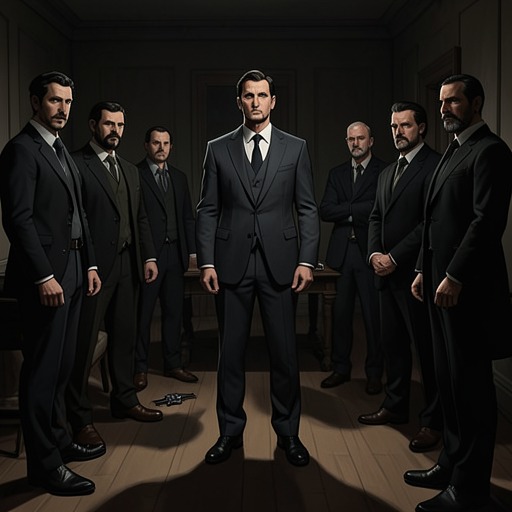
The purge gives Michael Corleone the reputation his earlier leadership had not yet secured. The Corleone Family returns to its primary place among the New York Families, and important caporegimes from both the Barzini and Tattaglia Families immediately defect to Michael. Tactical brilliance matters, but so does the demonstration that Michael can coordinate violence on a scale that his rivals cannot prevent or even fully anticipate. Power shifts because fear, information, and timing have been organized into a single command.
The victory is not emotionally clean. Constanzia Corleone returns from Las Vegas and denounces Michael, accusing him of killing Carlo after waiting until Don Vito Corleone was dead and no longer able to stop him. Her outburst exposes the cost of Michael's transformation within the family itself. The purge restores external order by creating internal terror: the brother who claims to protect the Family has become the person his sister most directly fears.
The final consolidation takes a year of delicate political maneuvering. Michael divides his time between the Long Beach mall and his new home in Las Vegas, then decides to close the New York operation and sell the houses and mall property. The structure that emerges is more centralized and geographically diversified: Peter Clemenza has his own Family, Rocco Lampone becomes a Corleone caporegime, Albert Neri heads security for the Family-controlled hotels in Nevada, and Tom Hagen belongs to Michael's Western Family. Michael's purge thus ends not with a single gunshot but with institutional rearrangement.
Its broader irony is that the Family's language of peace and self-government has always depended on organized coercion. Don Vito Corleone had once claimed that the Family would manage its own affairs against outside meddlers and had renounced vengeance for the common good. Michael inherits that rhetoric while acting through a private system of records, intermediaries, surveillance, uniforms, vehicles, and executions. The purge is therefore both a restoration and a mutation: it revives Corleone supremacy while replacing the old Don's visible web of personal favors with a more secretive, bureaucratic, and impersonal machinery of rule.